
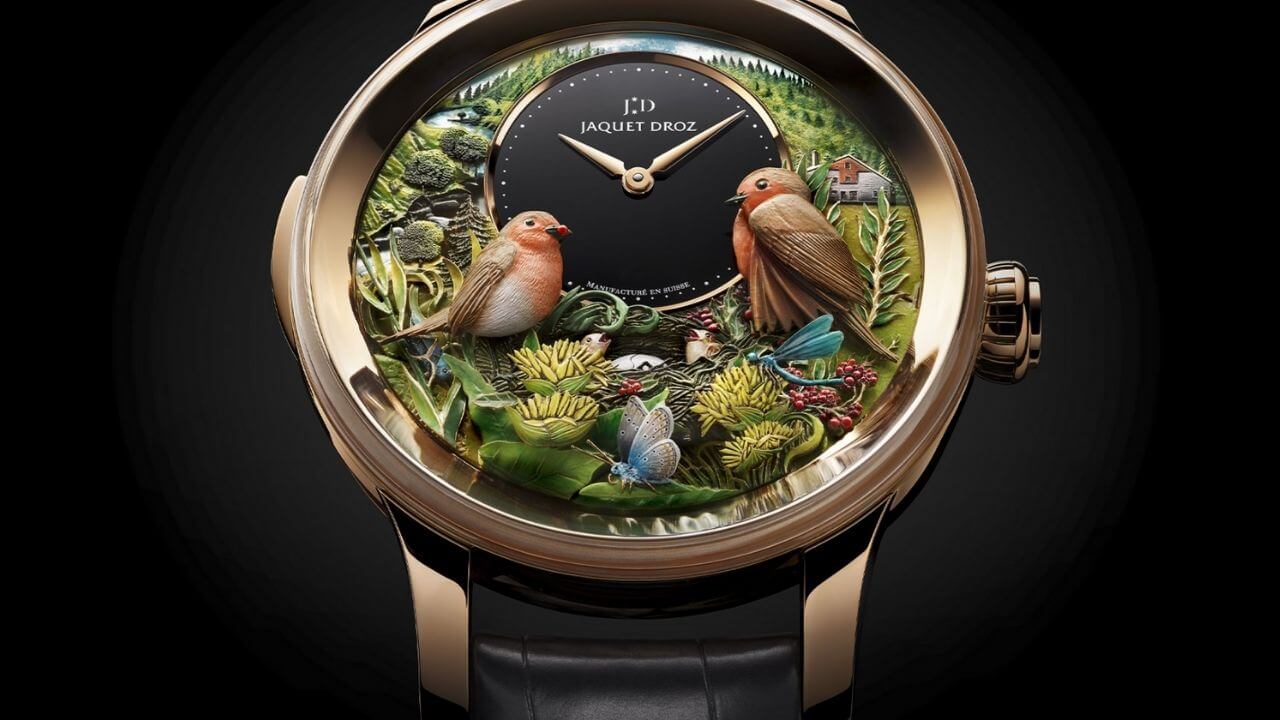
Today, I will write about Jaquet Droz, a very special brand for me and, I am sure, for many watch enthusiasts, and about its founder, Pierre Jaquet-Droz.
What makes it a special brand is not only its magnificent watches that you enjoy wearing on your wrist.
It is comparable to the respect felt for the genius of Da Vinci or the mechanical marvels of Al-Jazari. As you know, for many people the passion for mechanical watches stems from the magnificent design of those tiny parts, screws and gears. Requiring very precise calculation and brilliant imagination, these designs inspire an admiration that deepens the further you delve into them.

A watchmaker and mechanical genius far ahead of his time, Jaquet-Droz continues to astonish centuries later, both through the works he left to us with his own hands and through the current models of his brand, which has not lost the traces of his legacy despite having to go through two phases of modernisation.
Let us leave the current models for another article and travel back to the 18th century.
Pierre Jaquet-Droz was born in 1721 in La Chaux-de-Fonds, the heart of watchmaking. With the advantage of the land of his birth, he developed a serious interest in watchmaking and precision mechanics among the great watchmakers of the day, and soon realised he would devote his life to it.
At just 17, he had begun taking the first steps towards the legacy he would leave to the mechanical world. From 1738 to 1747, he devoted himself entirely to watchmaking. These were the years in which the first examples of the complicated mechanisms that major brands still add to their collections today to consolidate their image first appeared.
These increasingly complex mechanisms and functions born of fantastic imagination required demanding mathematical calculations and flawless handcraftsmanship.
Consider mechanical parts that, even with today’s technology, computer-aided design, laser and CNC cutting machines, can be produced by very few watchmakers, and imagine the mastery they required in the 1700s. When Jaquet-Droz’s precise manual skill, perfectionist character and, above all, the seriousness he brought to his art were combined with the flawless application of mechanical principles, the resulting works immediately began to attract attention. Another feature that set Jaquet-Droz apart from other watchmakers was the music boxes and automata he produced. Automata can be described as robots designed entirely mechanically.

The 1750s were the greatest turning point in his life.
Married with two children, Pierre lost both his wife and his daughter within a few years. While throwing himself entirely into his work in his grief, a major event for his international career occurred in the same years: he met George Keith, the Earl Marischal and Governor of Neuchâtel. The governor encouraged him to expand abroad, invited him to Spain and promised his support.
Before long, in 1758, Pierre Jaquet-Droz set off for Madrid with his watches. A few months later, he presented his works before King Ferdinand of Spain, captivating both the king and other members of the nobility. In addition to his watches, the automaton he had designed was also purchased by members of the royal family. This automaton took the form of a robotic dog with a basket of fruit in front of it, which barked whenever someone touched the basket.

Automata have always been Jaquet-Droz’s hallmark. The most famous of them, “The Writer“, “The Musician” and “The Draughtsman“, are still on display at the Museum of Art and History in Switzerland.
“The Writer“, one of his humanoid robots, which he began building in 1768 and completed with his son, is the figure of a child sitting at a wooden desk and writing. When set, this 70 cm figure can write any text of up to 40 characters with the quill in its hand. With very realistic movements, it dips the quill into the inkwell, shakes it to prevent drips and even follows the process by moving its head and eyes.
Another astonishing Jaquet-Droz automaton is “The Musician“, the figure of a woman seated at an organ. As she moves her fingers across the keys, following them with movements of her head and eyes, her chest also rises and falls very realistically, as if she were breathing. The most remarkable feature of this robot is that the music it plays does not come from any recording: the organ, designed specially for the automaton, is genuinely played by the robot.

“The Draughtsman“, like “The Writer”, is the figure of a child sitting at a desk holding a pencil, but this time it draws rather than writes. It can draw portraits of Louis XVI and Marie Antoinette as well as a dog and “Cupid” driving a chariot. As a charming detail, it periodically leans forward and blows, as if clearing away pencil dust.
Another standout among his many mechanical works is his music boxes with singing bird figures. Displaying incredibly realistic wing movements, these birds sing just as realistically through the compression of air in tubes within the mechanism. The synchronisation of movement and sound is so magnificent that one might mistake them for living birds.
If you do not have the chance to see them in a museum or at an event, I recommend finding and watching footage of these automata in action on video platforms. They are truly enchanting.

Acquired by the Swatch Group in 2000, the brand holds a distinct position within the group so that it can regain the success of its past and preserve its founder’s extraordinary legacy. While benefiting from all the resources of the Swatch Group, it acts with the freedom of an independent watch brand.
Today, it remains contemporary with models that are both modern and timeless and meet current demand, while continuing its life with respect for its past through works such as sound- and motion-producing mechanisms created entirely mechanically, and desktop writing automata that can reproduce your signature.


