
When I first started in the industry (1998) and heard the story of the “weeping emerald”, I was a little disappointed — the behind-the-scenes story of an incident built on mistrust in the world’s most trust-based industry..
And today, especially recently, with news of mistrust and fraud involving fake coloured stones and diamonds reaching fever pitch, I will begin this article, before giving any information about emeralds, by recommending certificates that are valid worldwide.
Diamonds have a certificate to guarantee their quality — certificates we call their identity papers, or even their birth certificates. And all coloured stones, including emeralds, have a “Coloured Stone Report”.
Coloured stone reports list every detail of the gem and help guarantee that it is a high-quality precious stone.
I recommend buying only — and I mean only — an emerald that comes with a coloured stone report issued by a reliable gem laboratory such as the Swiss Gemmological Institute SSEF, Gübelin Gem Lab, GIA or IGI.
Emeralds have been used in jewellery for more than 4,000 years. Could they ever go out of fashion?
Absolutely not!
They continue to bring their magnificent green beauty to wedding rings all over the world and, more importantly, they symbolise the love, hope and fidelity shared by every loving couple, from their 1st wedding anniversary to their 55th.
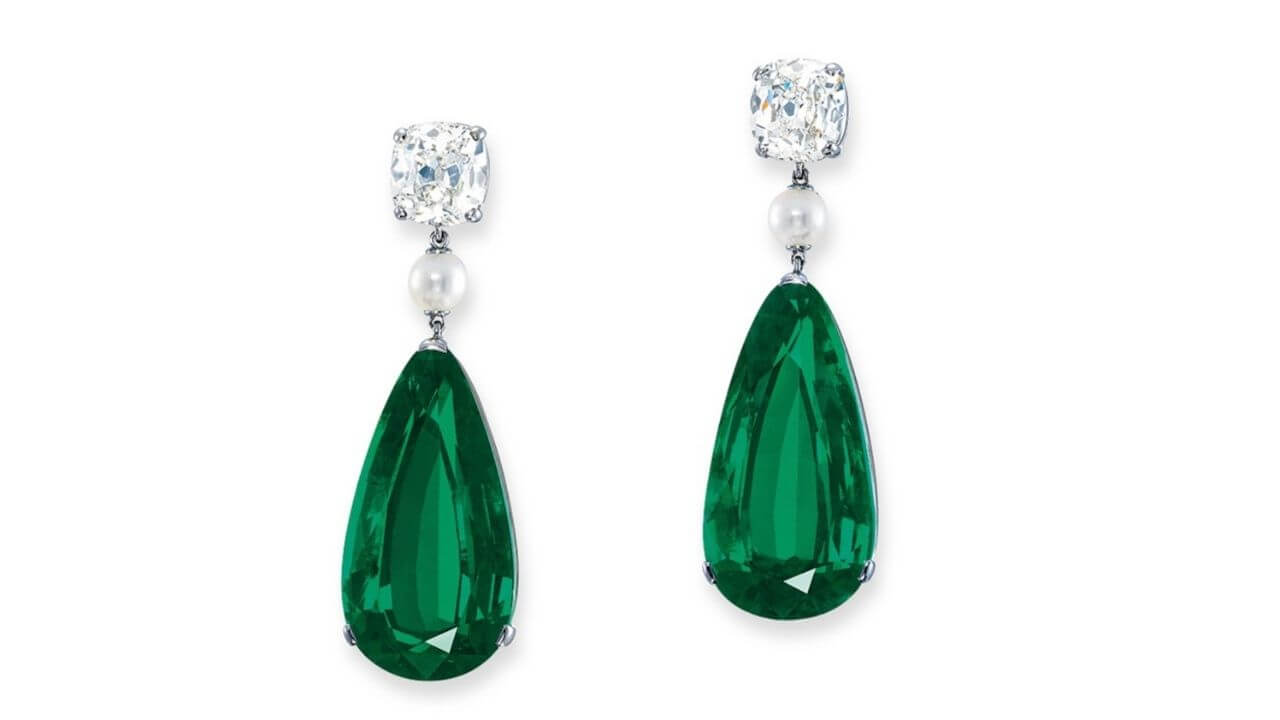
 A high-quality emerald has a vivid green colour with a medium to medium-dark tone. It will also have a limited number of inclusions that are well masked by its colour and cut. A high-quality emerald will also have a good cut that maximises the gem’s beauty and increases its overall strength.
3 Important Factors to Help You Choose an Emerald:
If you want to choose a high-quality emerald full of natural beauty, you need to consider the colour, clarity and cut of each emerald.
1. Choose the Right Shade of Green:
Most jewellers agree that an emerald’s colour is the most important factor affecting its overall value. An emerald’s colour is assessed using two specific characteristics: tone and saturation.
Emerald Hue.. An emerald’s hue refers to its overall colour. Hue includes the shade of green the gem is and any undertones it has. The most beautiful emeralds have a vivid green colour; if they have undertones, blue undertones are preferred over yellow. High-quality emeralds also have colouring with little or no colour zoning. Zoning occurs when trace metals within the gem are unevenly distributed, causing spots or “zones” that are a lighter or darker green than the rest of the stone. Tone refers to the depth of an emerald’s colour. An emerald can be light, medium or dark in tone, meaning its colour will be light green, medium green or dark green. The most valuable and attractive emeralds have a medium to medium-dark tone.
Emerald Saturation.. Saturation is the term used to describe the purity of an emerald’s colour. An emerald with a vivid green colour and little or no undertone has good saturation. An emerald with poor saturation will have strong undertones and a dull green colour. Emeralds with good saturation look their best in jewellery because they reflect light well and are more brilliant.
2. Make Sure There Are Few Noticeable Inclusions:
Emeralds almost always contain a lot of inclusions. These inclusions can be mineral fibres, tiny droplets of liquid, particles of other crystals or even tiny fractures. Most of these inclusions were present in the environment where the emerald formed and became trapped inside the gem.
Since it is almost impossible to find an emerald without any inclusions, it is important to find one with only a few — or, as we say in gem terms, one with good clarity.
An emerald’s clarity refers to how many inclusions the gem has, what kind they are and where they are located within it. An emerald with good clarity will have a limited number of small inclusions that do not detract from the gem’s overall beauty.
Most emeralds have considerable depth of colour, which naturally helps conceal their inclusions. When working with rough emeralds, gem cutters take the gem’s colour into account and cut it so that the colour masks the inclusions to an even greater extent.
Finding an emerald with few inclusions is as important for its strength as it is for its beauty. Emeralds with too many inclusions are often brittle and tend to crack more easily than stones with fewer inclusions.

3. Don’t Underestimate the Importance of the Cut:
The third factor to consider when looking for a quality emerald is its cut. An emerald’s cut plays an important role in determining the gem’s beauty and quality.
Rough emerald crystals are six-sided hexagons. Gem cutters take these hexagonal crystals and examine them thoroughly before they start cutting. They assess the crystal’s colour and its undertones from different angles, and also take detailed notes on the crystal’s inclusions and any large fractures or chips.
The cutters then give the emerald the cut that best captures its beauty. Emeralds can be given cushion, round, princess or even pear-shaped cuts, but many are given the emerald cut. The emerald cut gives the gem a rectangular shape with steps and linear facets on each side. Most emerald-cut emeralds also have cropped corners to increase their strength.
Whatever shape it gives the gem, an emerald’s cut strongly influences its ultimate beauty. A quality cut helps hide an emerald’s inclusions, minimises pleochroism and brings the gem to life by increasing the reflection of light.

**
Hitler’s scientists made synthetic emeralds to help fund the war effort. These stones were called “Igmerald”, but they were very small and the cost was very high, so the project was abandoned.
The largest stone produced by Carroll Chatham was 1,014 carats and is now in the Smithsonian Institution.
The process is still kept secret. As far as is known, the method is a “flux-growth” process: it starts with a sliver of natural emerald, around which a synthetic crystal is grown.
With Chatham’s method, an emerald crystal takes nine months to grow. To the naked eye the stone looks no different from a natural emerald, but according to gem experts it had very faint, feather-like lines and sometimes tiny platinum crystals.
**
Cleopatra’s love of emeralds became known when she seduced Caesar after his defeat of General Pompey in 49 BC.
**
Nero is said to have used emeralds as lenses in his theatre glasses to watch the games more vividly.
Because polished beryl stones, including emerald, were so widely used for this purpose, the German word “Brille”, meaning “glasses”, comes from “beryl”.

In Crete, there is a story of a marble lion statue with emerald eyes, looking out to sea from a rock near a fishing village.
According to the story, the fish, frightened by the statue’s glittering gaze, disappeared; but when the fishermen removed the emerald eyes, the fish came back and filled their nets again.
**
At one point Napoleon entered Rome and even looted the Vatican, taking a large emerald along with much of the treasure he found there. A few years later he returned the stone to Pope Pius, mounted on a tiara. The return of the stone was welcomed, but the way it was given angered the clergy: Napoleon had deliberately made the tiara too small to fit on the Pope’s head.
**
In 1809, as Empress Josephine was preparing to sit for her portrait, news broke that Napoleon would divorce her. When Isabey asked her which jewels she would wear for the portrait, Josephine sadly pointed to the emerald necklace her husband had given her earlier and said: “Paint me with emeralds — I want them to show my sorrow.”
**
English women abandoned by their husbands used to wear green clothes.
**
Aquamarine, said to bring luck to sailors, is the pale blue sister of the emerald and takes its name from clear, deep salt water.
In the past, seafarers often wore these stones to appease Poseidon, the god of the sea, and some would throw them into the sea when the waves rose too high.
History’s finest and most beautiful emeralds were mined at Muzo, 105 km north of Bogotá.
By wearing emerald jewellery, Middle Eastern and Mughal rulers showed not only that they were rich and powerful but also that they were protected by God.


